# NarrativeWorlds
An architectural framework for authorial control and game-state consistency in LLM-driven interactive digital narratives. Four components: typed authoring, social orchestration, operational state estimation, and consequence governance.
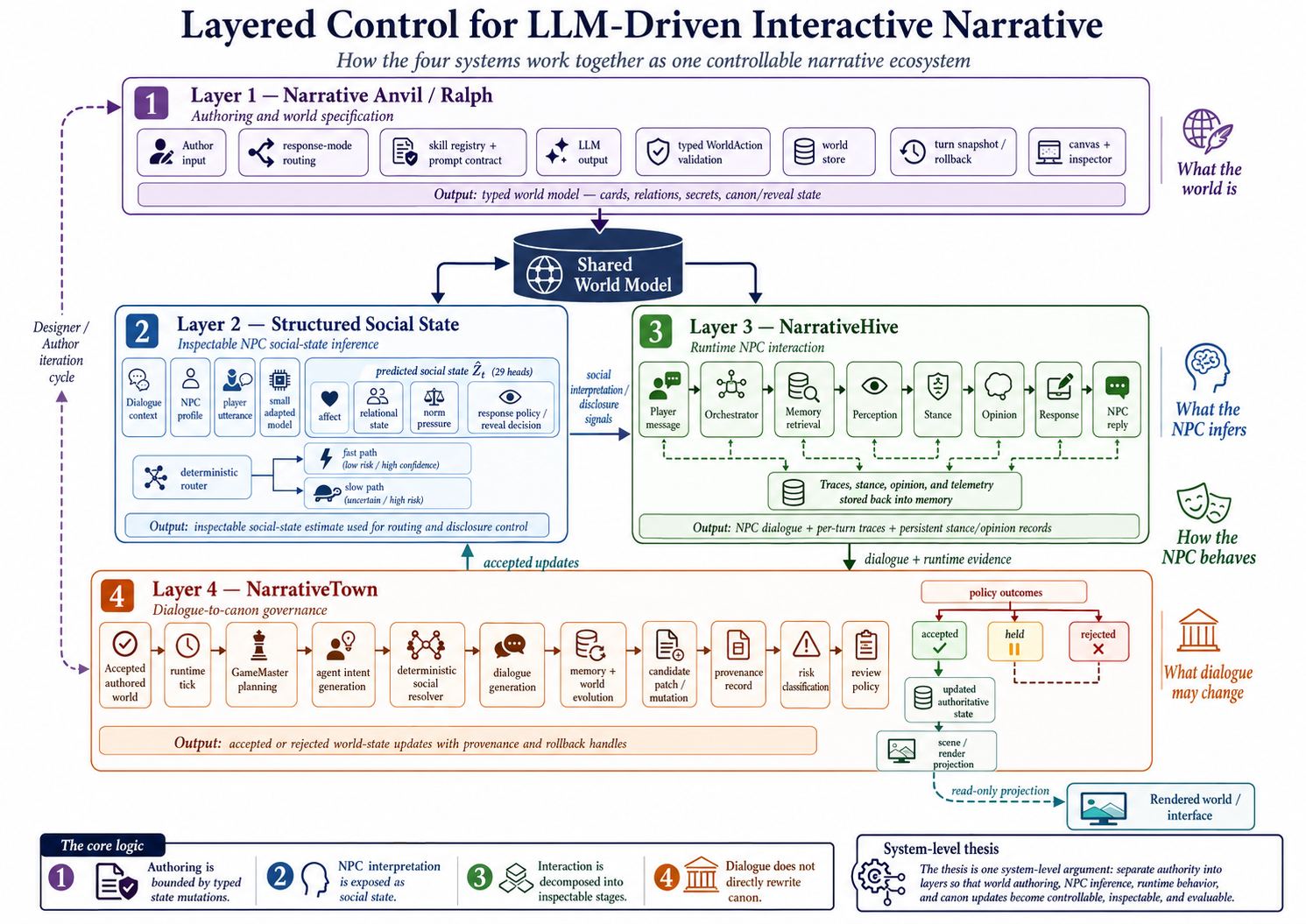
Overview
NarrativeWorlds is an architectural framework for locating and assigning authority around model-dependent decisions in interactive narrative. The thesis examines where model judgments acquire response or state authority, and defines authorial control as enforceable system-level authority over construction, consequential change, review, and reversal. Its authority-evidence rule requires a baseline or fault input capable of exposing failure at each permitted effect. Four components implement the framework: Narrative Anvil converts conversational authoring requests into typed, validated, reversible world edits through a card-and-graph world model. NarrativeHive records Perception, Stance, and Opinion before reply generation in a multi-agent pipeline with explicit social structure and reputation, evaluated with a 33-participant within-subjects study. NarrativeSignals predicts a 29-field NPC social state from synthetic-teacher supervision, training 15 models across four tracks: from-scratch SLMs (15-22M parameters), DistilBERT conditioning encoders, LoRA/QLoRA response generators, and a structured Qwen3-4B predictor with 29 classification heads and routing diagnostics. NarrativeTown governs provenance-linked session updates with deterministic social resolution, rule-based review policies, NLI-grounded evaluation, and projects engine-owned state to read-only renderers. The evidence supports architectural authority and game-state handling, not perceived author control or a deployed architecture.
Problem
LLMs broaden player input in interactive narratives, but their social reasoning remains hidden and dialogue can diverge from recorded game state. Authors need enforceable authority over construction, change, review, and reversal — not just perceived control.
Approach
Four bounded propositions implemented as separate systems: (1) Narrative Anvil converts conversational requests into typed, validated, reversible world edits. (2) NarrativeHive records Perception, Stance, and Opinion before reply generation in a multi-agent pipeline. (3) NarrativeSignals predicts a 29-field NPC social state from synthetic-teacher supervision across 15 trained models. (4) NarrativeTown governs provenance-linked session updates with deterministic social resolution and NLI-grounded review policies.
Impact
- * Narrative Anvil: typed validation contains malformed proposals; matched comparison measures containment rather than semantic quality.
- * NarrativeHive: 33-participant within-subjects study; positive paired differences on two composites passed within-composite correction.
- * NarrativeSignals: 15 models trained (dense GPT, PrefixGPT, MoE, Mamba-like, DistilBERT, LoRA/QLoRA, Qwen3-4B with 29 classification heads); basic router reached test F1 = 0.686.
- * NarrativeTown: accepted updates remained schema-valid, added no structural contradictions, and preserved projection agreement on tested paths.