# MorphoSeg CRP/HDP Explorer
Students and practitioners struggle to build intuition for CRP/HDP morphology. The task is to make the abstract process tangible and testable so people can connect symbols to outcomes.
Overview
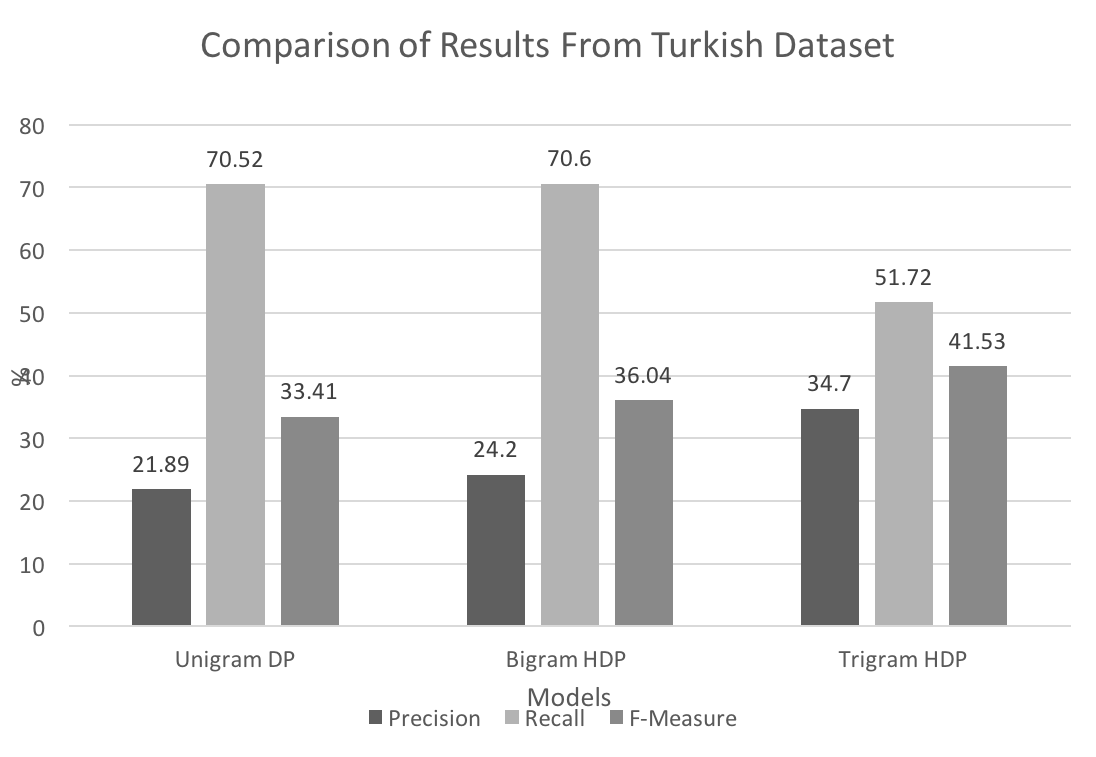
MorphoSeg grew out of our attempt to tame agglutinative languages for downstream NLP. Instead of treating every word as an atomic token, we slice it into morphemes — the smallest meaningful pieces — and feed those into translation systems, retrieval engines, or speech recognisers. The project combines two research threads: modelling morpheme chains with Hierarchical Dirichlet Processes (HDPs) and collapsing allomorph variants so the learner sees structure instead of surface noise. The HDP work treats each word as a sequence of dependent morphemes. A three-level model first samples the initial segment, then conditions each subsequent segment on the previous one, effectively learning morpheme trigrams without fixing vocabulary size. Even with modest training sets, those dependencies boosted F1 across Turkish, Finnish, and English compared to unigram assumptions. The follow-up study added an allomorph filter that maps surface variants (like Turkish plural endings -lar/-ler) to shared symbols before training. Pairing that with a bigram HDP cut sparsity and delivered the strongest scores in Morpho Challenge benchmarks, outperforming other allomorph-aware baselines.
Problem
Without an interactive mental model, reuse vs. novelty, concentration parameters, and segmentation quality feel like disconnected equations rather than one system.
Approach
Animate the CRP/HDP generative story (reuse vs. novelty) and pair it with runnable train/test experiments on English, Finnish, and Turkish datasets so users can tune priors and observe effects.
Impact
- * Moves from metaphor to measurable results in one place (no context-switching).
- * Reduces ramp-up time by letting users observe how priors change segmentation quality.
- * Bridges paper-level theory and reproducible interaction in the same learning flow.